
Tantalus is a figure from Greek mythology, most well known for angering the gods and getting tortured in Tartarus. His punishment consisted of him standing in a small pool with a tree bearing fruit hanging over him. Whenever he reached for the fruit, the branches pulled away; whenever he bent down to drink water, the pool would dry up. Everything being eternally out of his reach, whilst just having it being within sight of fulfilling his desires. Constant unsatisfied desire, this does not seem like an unfamiliar feeling.
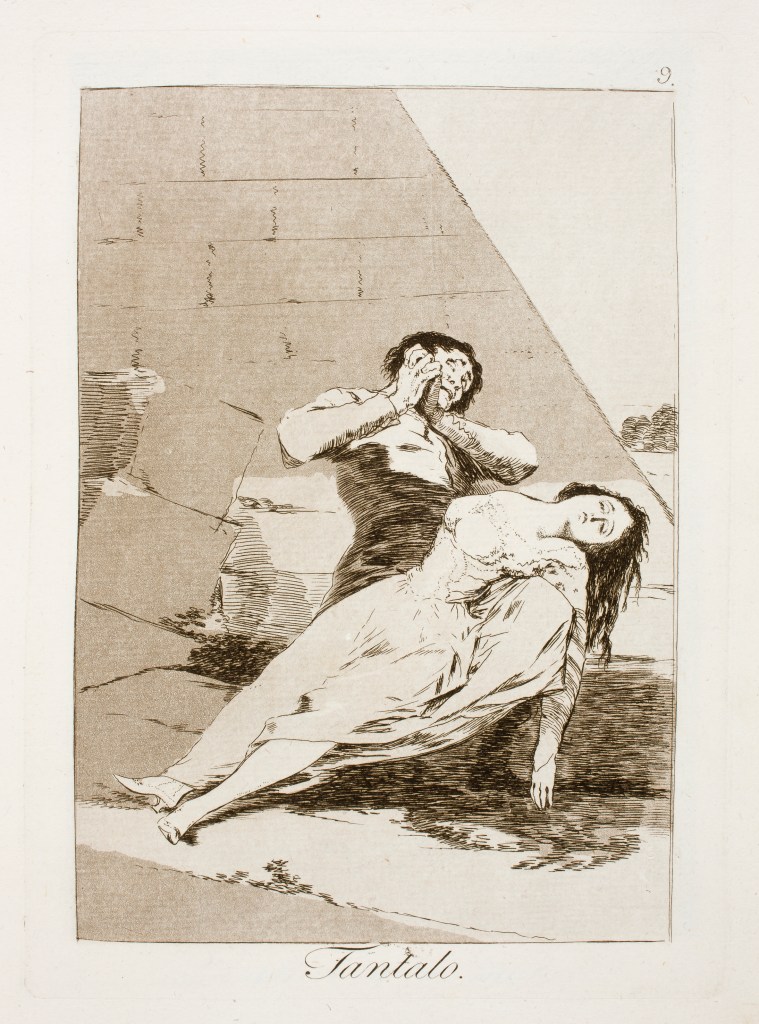
In Francisco Goya’s interpretation of Tantalus’ tale, he chooses to draw an old, ‘repugnant’ man with a beautiful, young woman laying across his legs. She is lifeless, her entire body limp as he cries out desperately. It is supposed that we must interpret her death as metaphorical, it is the death of sexual desire (despite it never existing in this relationship). Though it is the man that cannot satisfy the woman, she is the one who has been ‘killed off’. The texts that accompany this drawing see it as “a good woman alongside an old man who cannot satisfy her has fallen in a swoon, and it is like one who is dying of thirst, who is next to water but cannot bring it to his lips.” Though it touches upon the nature of unequal marriage, it doesn’t really have much to say about it. I can’t help but feel sorry for the woman laying in his arms. Her dress is lifted at the leg, exposing her thighs to this dirty old man, and her chest is wide open as he gets a full view of her body. Even though she is unsatisfied, he is still able to get some form of satisfaction from her – even if it does feel like torture.
Desire is difficult to define I suppose. For Tantalus, desire was simply about fulfilling his basic needs of survival. For the old man, it was about sexual desire. For the young girl, it was a desire to be freed from her marriage. When I come to think about my personal desires, I cannot figure out what it is that I long for.
 threehundredand10