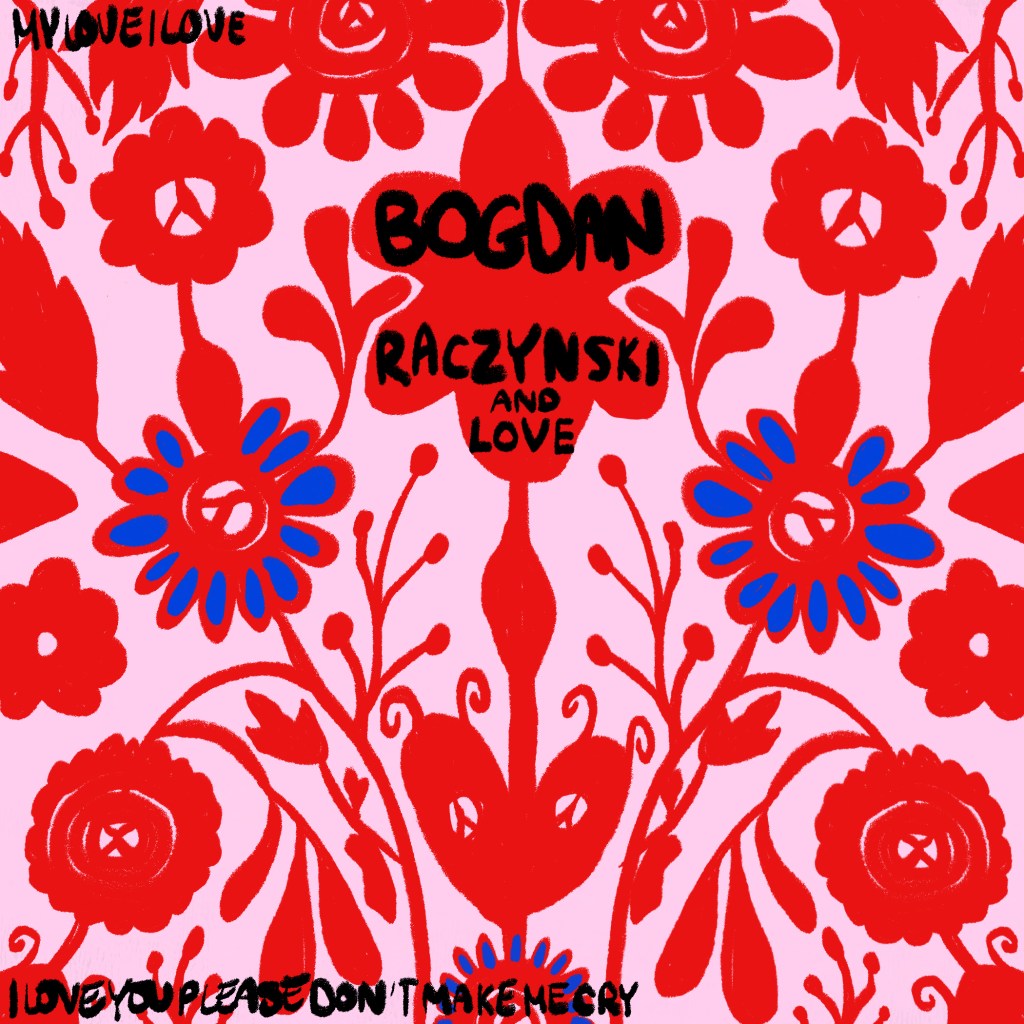
I LOVE YOU PLEASE DON’T MAKE ME CRY ANYMORE. Bogdan Raczynski’s album cover for his album myloveilove is an almost disturbingly personal image of him laying beside you, with a pink hue overlaid. It sets the tone for his 17 track masterpiece, which explores heartbreak through his out of tune singing and accordions and synths and a new way of perceiving the IDM genre entirely. Although many people see this as a sorrowful or disturbing album, all I gather from it is a sense of love. Initially it feels like the music is about rejection, but it’s about mourning past feelings and the recovery of the experience. That is not necessarily negative. In the cover it seems like he is smiling, and it all looks very nostalgic. Just because a moment has passed, doesn’t mean that memory is not beautiful. For me his music is about love and simplicity. This is not to say that his music is simple, but rather that it allows me to be simple and feel one emotion. There is joy behind his music that wishes to reach many. Although alternative music genres make it hard to reach the masses, there is no doubt that his entire discography will make you feel some sort of strong emotion.
Bogdan’s departure from Poland from a young age and adaptation to a new life is the main source of inspiration for his work. Being drawn to sound rather than language as he could not speak English, one can see how this played a part into the development of his musical style. Being a key figure of the Intelligent Dance Music genre (being previously signed to the Rephlex label), he still experiments with DnB, jungle, and traditional Polish folk music. He has spoken about how he has always aimed to be able to live off his work; but as a child of Polish migrants, has been able to identify with the barriers which can make this difficult. For many, being a creative and living off your craft is something that will require you to endure hardship. Not everyone has been learning to play the violin since they were 7, or were encouraged to pursue the path of arts. For many it’s not an option because the world is not built for everyone to take part in it. The way we look, the spaces we grew up in, how we are treated by the world – there is a privilege of growing up in secure, positive or encouraging environments. Bogdan constantly acknowledges this.
“There is no such thing as talent, it’s a word that robs people of being recognised for hard work or having the financial and other supportive means to even consider following their craft. And there truly are real social and political barriers and advantages that shape musicians and their music. We chalk things up to the talent.”
Yet this does not prevent people from creating. Bogdan started a platform that has harnessed a small community of artists whose only intention is to share their music. The website describes itself as an inclusive and diverse safe space for makers of interesting sounds, livecode, noise, software, visuals, and more. No ads, no tracking, and no tolerance for hate and discrimination.
Many online and offline spaces for music have become these gated and hateful spaces. This was not always true as in the past music has always been associated with community. The Acholi of Northern Uganda believe that music was responsible for ending their decade of conflict. Seeing that violence and hatred only occurs when one is able to dehumanise and stereotype their ‘enemy’ whilst maintaining that their own motivations are correct and positive – the only way to heal this rupture of human behaviour is by understanding relationships on an individual level. In Acholi musical tradition, songs are seen as a way to share “the innermost part of the individual who feels strongly about a subject within the social setting [that they live in]”. It is something deeply personal that must be shared with others within their group, and this is reflected in the collective thought that a village without music is dead. If we look at the art scenes in cities and current online spaces, there is a gap in intimacy and the creation of progressive music. Selected people are allowed to dominate, overruling smaller creators and destroying the accessibility of platforms. This is not to say that every song should be a heartfelt demonstration of the self, but rather that spaces should not flatten the opportunities for all works from all people.
His platform clang.gg is not defined by analytics or size or profitability, it is simply a place of solace. There is no expectation for it to be the homeground for a new style of music, or a massive push for it to grow rapidly. It very much feels as though Bogdan’s site holds the values of the early internet. The web used to be a place of pure freedom, allowing for collective organisation and discovery. Many artists from the net.art movement played with these ideas, as they saw the internet to be “free from any exploitation, tending naturally towards a democratic equilibrium and natural cooperation”. As the internet has become monopolised and disgustingly profitable, the reality for a digital utopia has melted away. Clang.gg is by no means fighting against this late capitalistic stage of the web, but it is a relief to see people creating digital pockets that reflect a lost ideal of the early internet. It is a safe space for subculture to exist, and with that it is enough. A lack of algorithms and monetisation means that people only create as much as they want to share. Whilst the site is not incredibly popular, I have been enjoying exploring the people and their craft – “make noise!”.
The final track of myloveilove feels like Bogdan has recovered from the heartbreak from the album. He has not overcome this love, as the sounds have been consistently repetitive through the listening experience. It rather feels like he has overcome the feelings of rejection whilst still being able to feel the love. To me, this album feels most reflective of his project [clang.gg]. A sense of love for music that makes you want everyone to have it.
Here are some reviews that random listeners have left online about myloveilove that I liked.
“una sensación tan extraña escuchando esto, es como dulce, tierno y una emanación de recuerdos que nunca sucedieron. y todo esto lo hace con una producción bien simple pero efectiva, me hace sentir mucho con poco. tendrá algunas canciones que no me gustan pero en su totalidad es una maravilla”
“Maybe I am an insensitive [person], but I really hate this CD. I prefer the old Bogdan. This music is very personal, and Bogdan’s singing voice makes me uncomfortable. Some music that people make should be kept private- not released.”
“Within the context of what I assume this album is about, it seems as if it’s attempting to allegorise the mending of a broken heart. All broken hearts are in reality, just you trying to fill yourself after part of you has left.”
“These are ugly and organic tunes to accompany the countless intricacies of love. Often times I find myself intoxicated by the music, recalling strange memories of pain.”
 threehundredand10