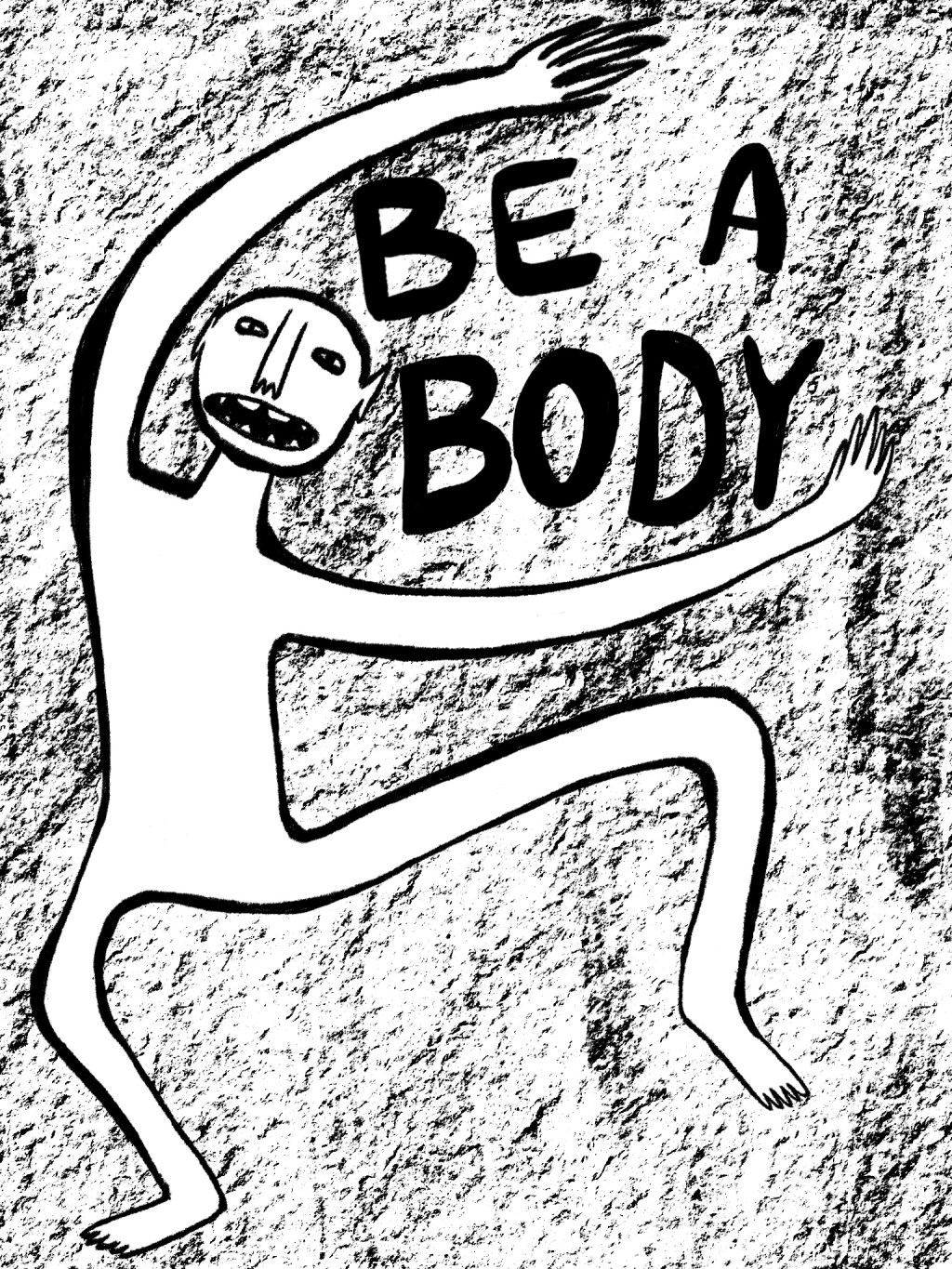
Whilst I let my body sink into the sofa cushions, I listened to Grimes’ 2012 Visions album for the thousandth time. Track 8 starts to play as I become intimately fused to the furniture, “Be a Body”. Unable to move, my mind spirals as I question what it even means to be a body. Grimes herself got the quote from Thomas Aquinas, the context being that he was trying to talk about how in Medieval Christian thought everyone was super into ‘fuck my life, my physical body is a horrible thing and a representation of sin’. Whilst she heard ‘be a body’ and took it as a way to comment on the post-human experience and how we feel pain/pleasure, Thomas Aquinas was rather similar in his commentary of trying to reground the human purpose to its physical boundaries (our bodies). This still left me in a rut, as I am not a 13th century Christian peasant or a cyborg [yet].
To achieve my new goal of understanding how to be a body, I needed to get a firmer grasp on what bodies even are. For some it is solely reduced to anatomical matters, to jars of organs and theatre surgeries. Developing from our confused understandings of the four humours, there came a point that the only way to understand the body was to dissect the unidentified deceased. Down the Old Town streets, I can imagine the fresh corpses being dragged to the underbelly of the university – whilst I try to think of easier methods of paying for my own rent. I myself have sat in the lecture theatres, been to the anatomy museums, even seen William Burke’s skeleton – which is perhaps a sick reflection of how times never really change. The 16th century allowed not just medical students to sit in on these dissections, but also the upper classes. No longer was it simply educational, but a performance which was put on for the elites. Blood was thrown across the room whilst flautists played to calm the agitated spectators. Even the design of these theatres were made for spectacle, making dissection a form of new media in this age. All the anatomical research of this time was intertwined with the creative arts as the ‘doctors’ used their imaginations to envision how the human body worked. Early anatomical drawings used saturated inks to depict dissected bodies in a surrealist manner, posed dramatically. Nowadays the drawings are much blander and we can no longer sit in a room watching madmen dissect robbed dead bodies. Modern medicine has lost these more creative traits but maintained the culture of dissection in a different manner. Doctors observe the human body in a fragmented manner, hoping to cure the disease rather than helping the human.
Pain and pleasure are arguably the body’s main purpose. In the context of Aquinas’ time, those two feelings are always intertwined. One can enjoy their sins only if they punish themselves afterwards; with peasants lashing themselves to the point of fainting after doing something ‘unholy’, just to restore the balance in their minds. The lines between pain and pleasure become more blurred in the present day with the popularised visuals of violent pornography. It can be seen as an extreme reaction to the reliance humanity has on technology, as we are entering a dystopian transhumanist version of reality. Some argue that without our physical selves, our existence has become wholly interchangeable with that of a computer – we have reduced ourselves to information. Through turning sex into something violent, we are creating an experience that a machine can never replicate. By creating this new performance that prioritises excess of emotion in every form, it is exploring every human experience at once. To be a body is to become acutely aware of every sense and emotion we have at once.
This is perhaps an unrealistic way to live, with a rather extreme example of how to do so. People spend their entire lives trying to wrap their heads around how they feel. Experiencing life means experiencing waves and surges of emotions, one minute you are crushed by your emotions and then you are completely numbed by them. I think grief epitomises this. Death is easy for the person who has gone, the true struggle is for those who carry on living. Anna Akhmatova’s poem ‘Requiem’ explores mourning in the most honest way I have ever read. She unravels the process of mourning from her own personal experience of it, following the Great Terror in Russia where many men died in Leningrad prisons. There is no plot in the traditional sense, but the ten lyric poems at the centre of the work chart a progression through emotional states as the speaker responds to the arrest, sentencing, and execution of her son. She understands the complex subject of grief like no other. By weaving herself in and out of the narrative, she manages to capture how universal grief is whilst showing how isolating and mentally disorientating it is. In grief, the shared common experience is loneliness. Whilst it seems this is irrelevant to being a body, what Akhmatova writes about is ‘living death’. “Kill memory, kill pain. Turn heart into a stone, and yet prepare to live again.” These women live in a space where time is blurred, living their lives out of order whilst the years pass by. They have died just as much as their loved ones have, arguably just becoming human bodies.
There is no satisfying conclusion to be made about being a body. We exist within different boundaries that constantly distort our senses of self, and it is our life’s task to try and understand this. What our bodies provide is shelter from a world that will bombard us with difficult questions and decisions. Looking back at the lyrics of the song, there is a line I find rather comforting. I close my eyes until I see I don’t need hands to touch me. We might feel confined by our physical states, but it is the most familiar place we will ever know.
 threehundredand10